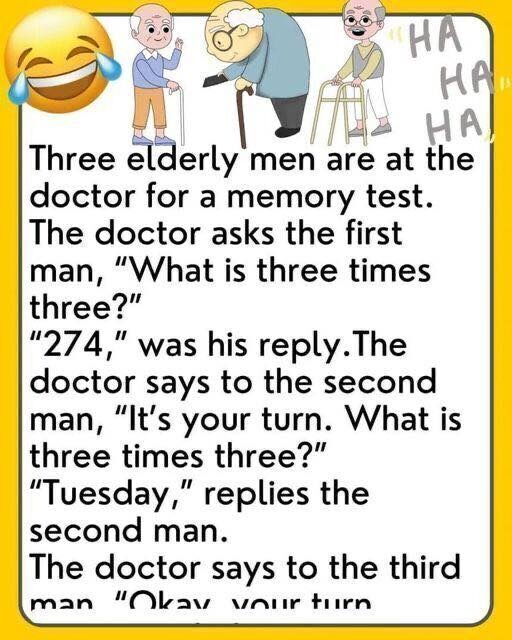
The waiting room of Dr. Aris’s clinic smelled faintly of peppermint and industrial-grade lemon wax, a scent that Arthur, Elias, and Julian had come to associate with the clinical indignities of their late seventies. They sat in a row of molded plastic chairs, three men who had navigated decades of fluctuating markets, changing regimes, and the shifting tides of their own families, now facing a challenge that felt smaller yet infinitely more daunting: a standardized memory assessment.
Continue reading...
When the nurse called them in together—a concession made because they refused to be separated—the atmosphere was thick with a performative bravado. Dr. Aris, a woman with a patient smile and eyes that had seen a thousand versions of this specific anxiety, laid out the first task. It was a simple subtraction exercise, meant to test focus and mental agility.
“Arthur,” she began softly, “could you subtract seven from one hundred, and then keep going?”
The room erupted. Not into the clinical concern the doctor might have expected, but into a chaotic, wheezing laughter that had been honed over fifty years of friendship. Julian chimed in, suggesting that the answer was likely “Tuesday,” because that was the day the trash went out and he couldn’t remember anything past that anyway.
In that sterile office, the fear that had been simmering under the surface for months began to lose its scald. The assessment continued through word-association games and clock-drawing tests. Julian drew a clock that looked more like a melting Dali painting, and Elias forgot the three words he was supposed to remember—apple, table, penny—within thirty seconds. But instead of the heavy, suffocating silence of failure, there was a strange, defiant lightness.
In the months that followed that day at the doctor’s office, the trio’s relationship underwent a subtle but profound transformation. The frustration that used to accompany a forgotten name or a lost set of keys was replaced by a gentle, shared language. They stopped correcting each other with the sharp precision of their younger selves. If Arthur told a story about a fishing trip in 1974 but placed it in 1982, Elias and Julian didn’t interrupt to fix the timeline. They simply stepped into the story with him, adding details they remembered—or thought they remembered—until the narrative became a collaborative tapestry, more beautiful for its inaccuracies.
This was the beauty of their resilience. They had discovered that memory was not the only proof of a life well lived. Society often treats the mind as the ultimate ledger of identity, assuming that if the data points vanish, the person vanishes too. But as they sat in that diner, nursing lukewarm coffees and sharing a single order of toast because they couldn’t remember if they’d already eaten breakfast, they proved the opposite. The proof of their lives wasn’t in the dates or the names; it was in the way they waited for each other at the door, the way they filled in one another’s missing pieces, and the way they chose kindness over the cold rigidity of facts.
“Lilacs,” Elias said softly, not missing a beat. “She loved the lilacs, Julian. And she always wore that blue dress with the white tiny flowers on the Sundays we went to the lake.”
Julian smiled, his eyes brightening. “Yes. The blue dress. Thank you, Elias. I could see the color, but I couldn’t find the word for the lake.”
They couldn’t always trust their minds to hold the data, but they could trust their bond to hold the essence. They were living in the slow drift of their later years, a time that many view with a sense of mourning for what is being lost. Yet, for these three, it was a time of unexpected discovery. They found that when you stop clinging so tightly to the “what” and the “when,” you have more room to hold onto the “who.”
Laughter became their primary defense mechanism against the encroaching shadows. When one of them would walk into a room and completely forget why he was there, the other two would follow him in and pretend they were also on a top-secret mission that had just been declassified. They turned the indignities of aging into a long-form improvisational comedy set, one where the audience was just the three of them, and the reviews were always glowing.
They got up to leave, moving a bit slower than they used to, their gait a little less certain. They held onto each other’s arms as they navigated the uneven pavement of the park path. They were a collective unit, a three-headed memory bank where the total was always greater than the sum of its faltering parts.
“Hey, Artie,” he said. “Subtract 274 from Tuesday.”
Arthur grinned, his eyes twinkling behind his thick lenses. “The answer is ‘more coffee,’ Elias. Always more coffee.”
They drove home—slowly, and perhaps with a few wrong turns—but they were never lost. Because as long as they had each other to fill in the blanks, they were exactly where they were supposed to be. They had mastered the art of holding on to joy, proving that while the mind may eventually release its grip on the past, the heart has a much longer, much more stubborn memory.
